
Endocrine-safe skincare is formulated without ingredients shown to mimic, block, or otherwise interfere with the body's hormone signaling, including parabens, phthalates, PEGs, cyclic silicones, sulfates, and synthetic fragrance compounds. "Clean" is a marketing term with no legal definition. "Endocrine-safe" is a formulation standard tied to specific, named chemical classes.
"Clean beauty" has no legal definition, no regulatory body, and no agreed-upon ingredient list. Any brand can put the word on a label. "Endocrine-safe" is different. It refers to a specific, testable claim: a product is formulated without ingredients shown to interfere with hormone signaling in the body. This guide breaks down what that means, how the science works, and which ingredient categories Halik excludes to meet that standard.
The Word "Clean" Doesn't Mean What You Think
Walk down the skincare aisle and the word "clean" is everywhere. It sits on drugstore serums, department store creams, and everything in between. The problem is simple. Nobody defines it the same way twice.
One brand uses "clean" to mean no parabens. Another uses it to mean no artificial colorants. A third uses it purely as a vibe, a green label and a leaf icon, with no ingredient standard behind it at all. The FDA does not regulate the term. Neither does the FTC in any specific, enforceable way. That leaves "clean" open to whatever a marketing team decides it should mean this quarter.
"Endocrine-safe" closes that gap. It points to a defined mechanism, hormone interference, and a specific set of chemical classes with documented links to it. A product can call itself clean and still contain those chemicals. A product cannot call itself endocrine-safe under the same conditions, at least not accurately.
What "Endocrine-Safe" Actually Means
The endocrine system is the body's chemical messaging network. Glands release hormones, estrogen, progesterone, testosterone, thyroid hormone, and cortisol among them, into the bloodstream. Those hormones travel to receptors throughout the body and regulate growth, metabolism, reproduction, mood, and development.
Endocrine-disrupting chemicals, often abbreviated EDCs, interfere with that system. Some xenoestrogens bind to estrogen receptors and mimic or block the action of the body's own estrogen. Others block hormone receptors outright, preventing real hormones from doing their job. Others interfere with the enzymes that build or break down hormones in the first place.
A formula is endocrine-safe when it excludes ingredients documented or strongly suspected to act through any of these mechanisms. That is a formulation choice, not a slogan. It requires knowing the mechanism behind each excluded ingredient, not just avoiding a word on a label.
How Synthetic Chemicals Cross the Skin Barrier
Skin is a remarkably effective barrier, but it is not impermeable. Small, fat-soluble molecules, the kind common in synthetic preservatives, plasticizers, and fragrance compounds, can move through the outer skin layers and into the bloodstream. Products applied daily and left on the skin, lotions, creams, and balms among them, offer repeated opportunities for that absorption to happen.
This is part of why endocrine safety matters more in personal care than in a single, occasional exposure. A body lotion applied every morning delivers its ingredients to the skin, and in some cases the bloodstream, day after day for years. Cumulative, low-dose exposure is the pattern researchers watch most closely, because hormone signaling can respond to very small amounts at the wrong time.
How These Chemicals Mimic or Block Hormones
Three mechanisms come up again and again in the research on cosmetic ingredients and hormone disruption.
Mimicry. Some synthetic molecules are shaped closely enough to a natural hormone, most often estrogen, that they can bind to the same receptor and trigger a similar response. Parabens can act like estrogen in the body and disrupt the normal function of hormone systems tied to reproductive development and function.
Blocking. Other molecules bind to a hormone receptor without activating it, occupying the site so the real hormone cannot dock there and deliver its signal.
Enzyme interference. A smaller group of compounds interferes with the enzymes that activate or deactivate hormones inside the body. Research on parabens has found that several of them inhibit an enzyme involved in regulating active estrogen levels.
None of these mechanisms require a large dose to matter. Hormone signaling depends on timing and concentration, not the simple, higher-dose-equals-higher-risk logic that applies to many other kinds of chemical exposure.
The Ingredient Categories Halik Excludes, and Why
A formulation standard is only as strong as the specificity behind it. Here is the mechanism behind each category Halik formulates without, and why the reasoning differs by ingredient.
Parabens
Parabens are preservatives used to extend shelf life in water-based formulas. Parabens enter the body through dermal absorption and can enhance the action of the body's natural estradiol. The U.N. Environment Programme has identified parabens, including propylparaben and butylparaben, as endocrine-disrupting or potential endocrine-disrupting chemicals. Halik formulates without parabens across every product line.
Phthalates
Phthalates are typically used as fragrance solvents and plastic softeners rather than named, standalone ingredients. They can bind to hormone receptors, block normal hormone production, or mimic hormones outright. Because phthalates most often enter a formula through synthetic fragrance, excluding synthetic scent removes this risk at the source.
PEGs (Polyethylene Glycols)
PEG compounds are humectants and emulsifiers with two separate concerns attached to them. Manufacturing can leave residual contamination from ethylene oxide and 1,4-dioxane, both classified as potential carcinogens. PEGs are also known to enhance skin penetration, which raises the chance that other ingredients in a formula absorb more readily than intended. That second property matters even in a formula that otherwise meets an endocrine-safe standard, since it can increase absorption of anything else present.
Cyclic Silicones (D4 and D5)
This is where precision matters most. Silicone as a category is broad, and most silicone polymers used in cosmetics carry no documented hormone concern. The issue is narrower and specific to two compounds, D4 (octamethylcyclotetrasiloxane) and D5 (decamethylcyclopentasiloxane). The European Union classifies D4 as an endocrine disruptor based on evidence that it interferes with human hormone function. The EU has restricted D4 and D5 in rinse-off cosmetics since 2020, with a broader ban on leave-on products following in 2026. Halik excludes these two cyclic siloxanes specifically, rather than treating every silicone-derived ingredient as equally concerning.
Sulfates
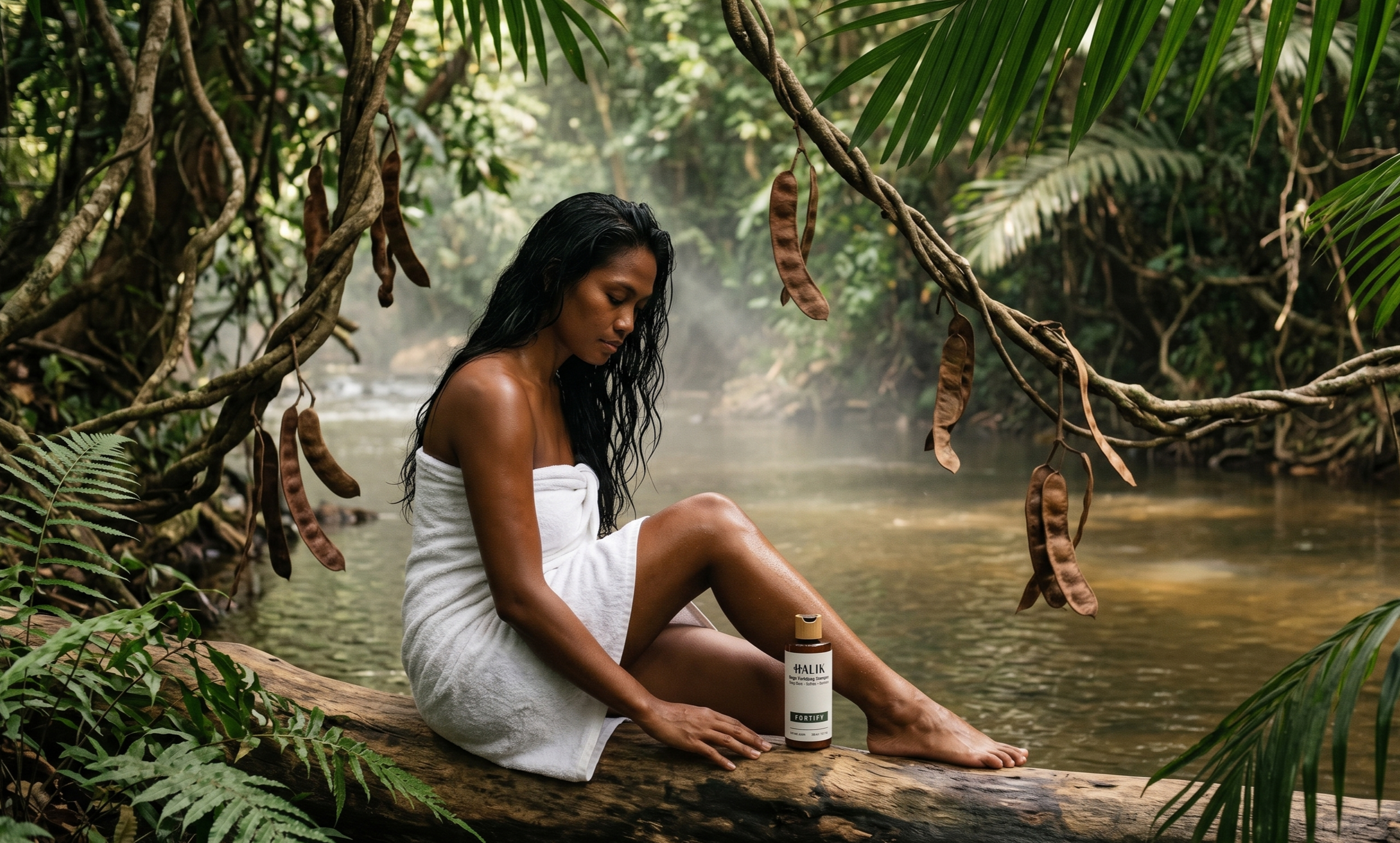
Sulfates are foaming and cleansing agents, and they deserve their own, separate reasoning. The documented concern with sulfates is barrier disruption, not hormone interference. Harsh sulfates can strip the skin and scalp of natural oils, leading to irritation, dryness, and a compromised moisture barrier. As seen in their Gugo Fortifying Shampoo, Halik avoids harsh sulfates for that reason, skin barrier integrity, not because sulfates function as endocrine disruptors themselves.
Synthetic Fragrance
"Fragrance" or "parfum" on a label can legally represent dozens of undisclosed chemicals, protected as a trade secret under U.S. labeling law. Phthalates and synthetic musks are the two chemical classes most consistently identified as endocrine disruptors within fragrance blends. Because the individual compounds inside a synthetic fragrance are never disclosed, there is no way to verify what a "fragrance" ingredient actually contains. Halik formulates with essential oils and botanical extracts for scent instead, where every component is named and traceable. As seen with their Bayabas Nourishing Face Cream, its subtle scent comes from unrefined guava seed oil rather than an undisclosed “fragrance.”
Why We Chose This Standard
Heritage. Filipino beauty tradition never separated what touched the body from what the body absorbed. Botanicals like gugo bark and calendula were selected for function, passed down and refined, not marketed with vague purity language.
Health. Halik was founded on a personal path toward better endocrine health, and that history shapes every formulation decision made since. Excluding a documented hormone disruptor is not a trend to follow. It is the baseline the brand was built to meet.
Harmony. An endocrine-safe standard is a promise about the relationship between a product and the body wearing it. Botanical ingredients and the body's own biology are meant to work together, not against each other.
Clean Beauty vs. Endocrine-Safe Beauty
| "Clean" Beauty | Endocrine-Safe Beauty | |
|---|---|---|
| Definition | Unregulated marketing term | Formulation standard tied to hormone-interference mechanisms |
| Regulatory body | None | Informed by EU REACH, FDA, and peer-reviewed toxicology |
| What it excludes | Varies by brand, often undisclosed | Named categories: parabens, phthalates, PEGs, cyclic silicones, sulfates, synthetic fragrance |
| Ingredient transparency | Optional | Full INCI disclosure, including fragrance components |
| Verifiable by the consumer | Rarely | Yes, against a published ingredient list |
A Ritual Built on What It Leaves Out
Every Halik formula starts with a question most brands never ask out loud. Does this ingredient interfere with how the body regulates itself? If the answer is yes, or even uncertain, it does not make it into the bottle. That standard shapes the ingredient list before a single botanical is chosen for scent or texture.
Reading a label should not require a chemistry degree, but it should never require blind trust either. Every full ingredient list on shophalik.com is public, INCI names included, so you can verify the standard yourself rather than take a marketing claim at face value.
A kiss from Mother Earth, formulated with what your body deserves to absorb.
FAQ
-
Endocrine-safe skincare is formulated without ingredients shown to interfere with hormone signaling in the body, including parabens, phthalates, PEGs, cyclic silicones, sulfates, and synthetic fragrance compounds.
-
No. "Clean" is a marketing term with no legal definition and no regulatory body behind it. "Endocrine-safe" refers to a defined mechanism, hormone interference, and a specific set of chemical classes with documented links to it.
-
Parabens can act like estrogen in the body and disrupt the normal function of hormone systems tied to reproductive development and function. Phthalates can bind to hormone receptors, block normal hormone production, or mimic hormones outright.
-
No. The documented endocrine concern is specific to two cyclic silicones, D4 and D5, not silicone-derived ingredients as a whole. Halik excludes D4 and D5 specifically rather than treating every silicone as equally concerning.
-
The documented concern with sulfates is barrier disruption, not hormone interference. Harsh sulfates can strip natural oils and compromise the skin and scalp barrier, which is why Halik avoids them.
Related Reading




About Halik
Halik is a clean, premium skincare brand inspired by Filipino botanicals and the healing power of natural ingredients. All Halik products are formulated without parabens, PEGs, phthalates, silicones, sulfates and synthetic fragrances.
