The Chemistry of Clean Suds: How Natural Shampoo and Conditioner Actually Work
Conventional shampoos rely on sulfate surfactants like SLS that cleanse effectively but strip the scalp's natural moisture barrier. Clean alternatives use plant-derived surfactants such as glucosides and isethionates that remove debris without disruption. In conditioners, the key concern is cyclic silicones (D4/D5), classified as endocrine disruptors under EU regulation, which clean formulas replace with plant-derived agents like behentrimonium methosulfate and guar hydroxypropyltrimonium chloride. The performance difference is real during a transition period while the scalp recalibrates, but long-term clean formulas support scalp health without the accumulation or endocrine concerns of conventional options.
There is a moment in the shower when the lather rises and something in the brain says: this is working. That feeling has been engineered – and for decades, it has been built on the same small handful of synthetic compounds, optimized less for your scalp's biology and more for your sense of expectation.
Understanding what actually happens when shampoo meets hair, and what makes a clean formula perform differently than a conventional one, is not a minor distinction. It gets at the heart of what we put on our scalps every wash day, which is one of the most absorbent, microbially rich, hormonally sensitive surfaces on the body.
The Scalp Is Not Just Skin
Before the chemistry, a grounding note: the scalp is skin, but skin in a particularly complex environment. It is dense with sebaceous glands that produce the natural oils keeping hair lubricated and the barrier intact. It hosts a microbiome that, when balanced, supports a healthy hair growth cycle. And it sits directly above a dense capillary network that is efficient at absorbing what we apply to it.
Shampoo does not simply rinse away. Some portion of every formula is absorbed, which is why what goes into the bottle matters in ways that extend beyond how your hair looks after drying.
How Conventional Shampoos Produce a Lather
The active cleansing agents in shampoo are called surfactants (from surface active agents). Their molecular structure has a water-loving (hydrophilic) head and an oil-loving (lipophilic) tail. When surfactants contact the sebum, styling product, and environmental residue on hair, the oil-loving tail binds to the debris while the water-loving head stays oriented toward the rinse water. The result is a micelle: a tiny sphere that encapsulates the oil and carries it away.
Conventional shampoos most commonly rely on sodium lauryl sulfate (SLS) or its slightly milder sibling sodium laureth sulfate (SLES) as their primary surfactant. These are sulfate-based anionic surfactants, meaning they carry a negative charge, and they are extraordinarily effective at producing abundant foam and stripping oils from the hair shaft.
The problem is not that they work. The problem is how well they work. SLS in particular does not distinguish between the sebum your scalp needs to maintain barrier integrity and the product buildup you actually want removed. It strips both. Over time, this disruption can signal the sebaceous glands to overproduce oil in compensation, a cycle many people mistake for naturally oily hair.
Sulfates, it is worth being precise about, are not classified as endocrine disruptors. Their concern is primarily one of barrier disruption and irritation potential, particularly for color-treated, textured, or sensitized hair and scalps.
What Clean Shampoos Use Instead
Clean formulas replace high-irritation sulfates with gentler plant-derived surfactants that still cleanse effectively but leave the scalp's moisture barrier closer to intact. The most common categories:
Coco-glucosides and decyl glucosides are derived from coconut oil or glucose (typically from corn or wheat). They are non-ionic surfactants, meaning they carry no electrical charge, which makes them significantly less likely to disrupt the scalp's slightly acidic pH or strip the lipid barrier.
Sodium cocoyl isethionate (SCI) is a fatty acid ester derived from coconut oil. It is mild, conditioning, and produces a creamy rather than voluminous lather, a sensory difference that takes some adjustment but does not reflect reduced cleaning efficacy.
Sodium lauroyl methyl isethionate offers similar gentleness with slightly better rinsability in hard water.
Disodium lauryl sulfosuccinate is sometimes used in clean formulations as a foam booster. It’s milder than SLS, better tolerated by sensitive scalps.
None of these produce the same dense foam as SLS. That foam expectation is one of the first things clean beauty asks you to recalibrate, not because lather is functionally required for cleansing (it is not), but because decades of conditioning have made it feel necessary.
The Halik Approach: Gugo and Botanical Synergy
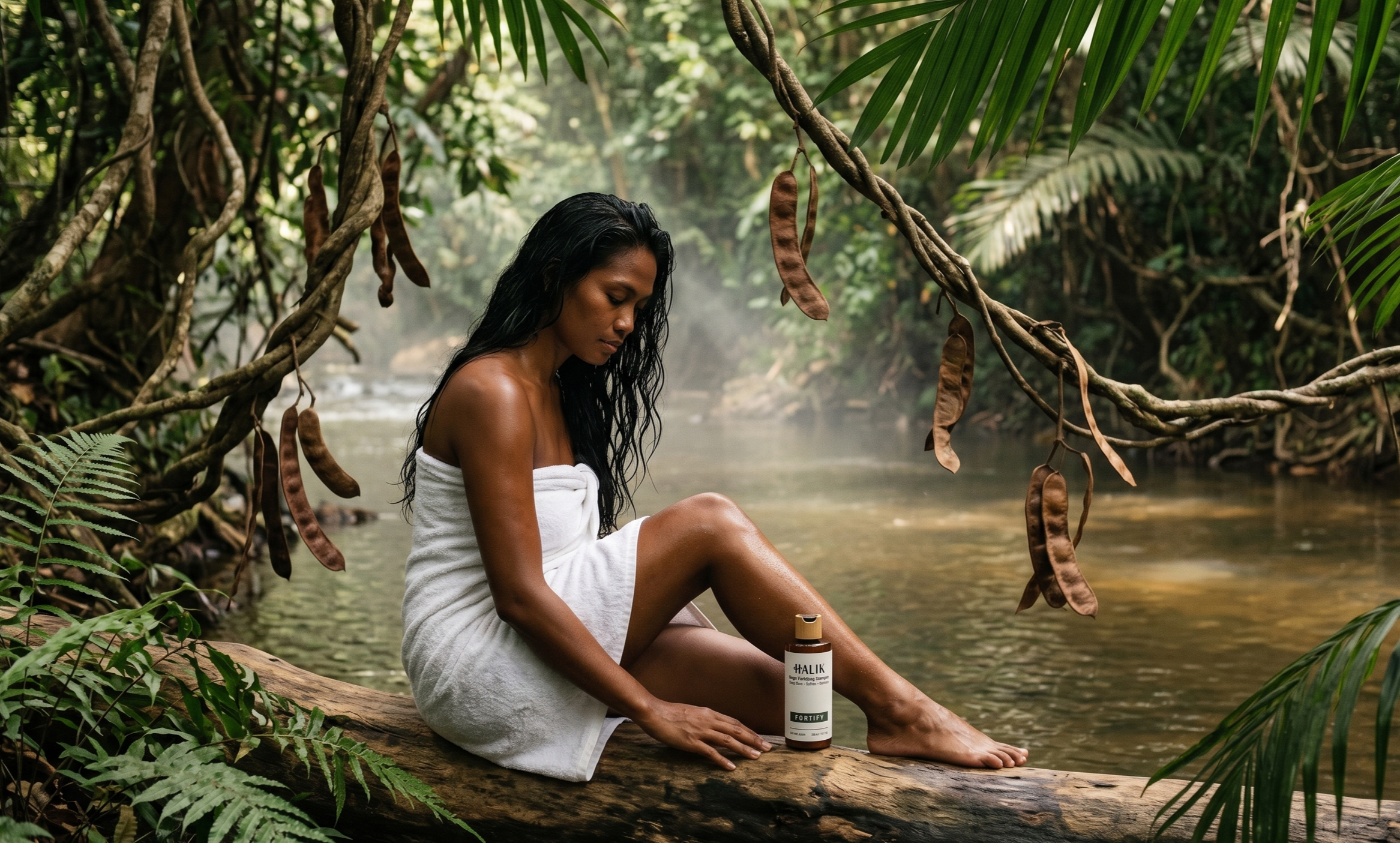
The Gugo Fortifying Shampoo was built on this principle of effective gentleness. The botanical anchor is gugo bark (entada phaseoloides), a forest vine used across the Philippine archipelago for generations as a natural hair cleanser. Gugo bark is rich in saponins, which are plant-derived compounds with their own natural surfactant activity, produced when the bark is worked into a lather with water.
What makes gugo meaningful beyond its heritage story is that saponins cleanse without the harshness of synthetic sulfates. They have a lower foaming threshold, they are more compatible with the scalp's lipid layer, and they bring with them the tannins, flavonoids, and phytosterols present in the whole bark compounds that support scalp circulation and condition the hair shaft as they cleanse.
The shampoo formula pairs gugo with plant-derived surfactants and conditioning botanicals, producing a wash that removes what needs to be removed without leaving the scalp compromised.
How Conventional Conditioners Work
After stripping the hair with an anionic surfactant, conventional conditioners face a predictable challenge: the hair shaft is now negatively charged from all that anion exposure, and the cuticle is lifted. Enter cationic (positively charged) conditioning agents, i.e. primarily quaternary ammonium compounds (quats) and silicones.
Because opposites attract, cationic ingredients adhere readily to the negatively charged hair shaft. They smooth the cuticle, add slip, and reduce static. This is why conventional conditioners often feel immediately, intensely effective the chemistry of attraction is doing exactly what it was designed to do.
Cyclic silicones, specifically D4 (cyclotetrasiloxane) and D5 (cyclopentasiloxane), have historically been the industry's go-to slip and shine agents. They coat the hair shaft in a smooth silicone film, creating the sensation of softness and manageability. But cyclic silicones are classified as endocrine disruptors by the European Chemicals Agency and are restricted in wash-off products under EU regulation. They also build up on the hair shaft over time, creating the paradox of hair that feels silkier until it no longer does – and then requires a harsher stripping wash to start the cycle again.
Not all silicones are created equal, and not all quats are equivalent either. Industrial quaternary ammonium compounds – the kind found in antimicrobial cleaners and fabric softeners – are a different category of concern from the cosmetic-grade conditioning agents used in quality hair care. The distinction matters.
What Clean Conditioners Use Instead
Clean conditioning formulas swap high-concern silicones and quats for plant-derived alternatives that work with the hair's biology rather than coating over it.
Behentrimonium methosulfate (BTMS) is a plant-derived conditioning emulsifier derived from rapeseed oil. It has cationic properties that help it bond to hair and smooth the cuticle without the accumulation concerns of silicone films. It is among the most well-tolerated conditioning agents in clean beauty and is recognized as acceptable under Ecocert and Cosmos standards.
Guar hydroxypropyltrimonium chloride (often listed as "guar" on marketing materials) is derived from the guar plant. It provides slip, detangling, and moisture retention, functioning similarly to synthetic polymer detanglers but from a plant source, and without the endocrine disruption concerns associated with cyclic silicones.
Oils and butters such as babassu, argan, jojoba and marula provide emollient conditioning through fatty acid penetration rather than surface coating. Rather than creating the illusion of smooth hair, they contribute to actual moisture balance in the cortex.
Proteins, particularly hydrolyzed keratin and silk amino acids, fill gaps in the cuticle and support tensile strength. It is worth noting that hydrolyzed keratin is most commonly derived from animal sources (typically wool); brands committed to full ingredient transparency name the sourcing.
The Performance Gap: Expectation vs. Reality
The most common friction point between clean and conventional hair care is the transition period. When you move away from sulfates, the scalp's sebum production, which is calibrated to the stripping cycle, takes time to recalibrate. During those early weeks, hair can feel heavier or oilier than usual. This is not the clean formula failing. It is the scalp adjusting to a new equilibrium.
Similarly, when you remove silicone-based conditioners, hair may initially feel less smooth. What you are feeling is the hair without its coating, and for some hair types, particularly high-porosity, this can read as dryness or texture before plant-based conditioning agents have had time to build their own effect.
Understanding this as a recalibration rather than a failure changes how people experience the shift. And those who stay with it often describe the outcome in the same terms: hair that holds moisture longer between washes, a scalp that is calmer and less reactive, and a general sense that the hair is behaving more like itself rather than performing a version of itself.
The transition window varies; most people land somewhere between two and six weeks before the scalp finds its footing.
What the Botanical Approach Actually Delivers
Once the scalp has recalibrated, the difference between a botanical formula and a conventional one becomes less about what is absent and more about what is actively present.
Plant-derived surfactants do not just cleanse more gently; many bring functional secondary benefits that synthetic surfactants do not. Saponin-rich botanicals like gugo bark support scalp circulation. Lauryl glucosides derived from coconut carry inherent antimicrobial properties. Sodium lauroyl oat amino acids, derived from oats, deposit conditioning proteins as they cleanse, beginning the restoration process before the conditioner ever touches the strand.
Botanical conditioning agents, such as baobab protein, hydrolyzed quinoa, bamboo extract, and meadowfoam oil interact with the hair shaft through penetration and bonding rather than surface coating. The result is moisture that lives inside the strand rather than sitting on top of it, which means it moves with the hair rather than washing off with the next shampoo.
For the scalp specifically, the botanical approach removes the cycle of disruption and compensation. When sebaceous glands are no longer being stripped and signaled to overproduce, they find a more natural rhythm. The scalp becomes less itchy, less reactive, and less dependent on the next wash to feel clean. Many people find that wash intervals naturally extend, not because they are waiting out discomfort, but because the scalp simply does not demand washing as urgently.
There is also something worth naming about what happens when you go back. Anyone who has switched to a clean formula for several weeks and then returned to a conventional shampoo – even briefly, even to finish a bottle – tends to notice what they had stopped noticing before: the tight, stripped feeling after lather, the scalp that itches within a day or two, the hair that looks conditioned but does not quite feel it. Sensitivity, once recalibrated, is hard to un-ring. What once felt normal starts to feel like a signal.
Reading the Label
A few practical signposts for evaluating a shampoo or conditioner formula:
Ingredients are listed in descending order of concentration. Water is typically first. The first five to eight ingredients represent the bulk of what you are applying to your scalp and hair.
Look for the surfactant name. If it contains "sulfate" (sodium lauryl sulfate, sodium laureth sulfate, ammonium lauryl sulfate), that is the flag. Gentler alternatives will list glucosides, isethionates, or sulfosuccinates.
In conditioners, look for "cyclopentasiloxane," "cyclotetrasiloxane," "dimethicone," or "amodimethicone" – these are the silicone markers. Dimethicone and amodimethicone are water-insoluble and accumulate on the shaft. Cyclic silicones (D4, D5) carry the added concern of endocrine disruption.
Fragrance listed as "fragrance" or "parfum" is a single ingredient that can represent dozens of undisclosed compounds, including phthalates, which are plasticizers that are endocrine disruptors and commonly used as fragrance fixatives.
The Suds You Can Trust
Clean hair care is not a compromise. It is a recalibration of chemistry, of expectation, and of what we understand effective cleansing to mean. Fewer ingredients of concern, more botanical intelligence, and a formulation philosophy that treats the scalp as the living ecosystem it is.
The lather may be quieter. The effect, over time, tends to speak louder.
FAQ
-
Yes. Plant-derived surfactants like glucosides and isethionates remove sebum, product buildup, and environmental residue effectively. They produce less foam than sulfate-based formulas — but lather volume is not a measure of cleansing efficacy. The transition period, during which the scalp recalibrates its oil production, is temporary; what follows is a cleaner baseline without the disruption cycle.
-
Cyclic silicones — specifically D4 (cyclotetrasiloxane) and D5 (cyclopentasiloxane) — are synthetic compounds used in conventional conditioners to add smoothness and shine. They are classified as endocrine disruptors by the European Chemicals Agency and are restricted in wash-off cosmetic products under EU regulation. They also accumulate on the hair shaft over time, requiring increasingly harsh cleansers to remove — which restarts the stripping cycle.
-
Gugo bark (entada phaseoloides) contains natural saponins — plant compounds with surfactant properties that cleanse the hair and scalp without the harshness of synthetic sulfates. Used across the Philippine archipelago for generations, it also brings tannins, flavonoids, and phytosterols that support scalp health and condition the hair shaft as they cleanse — something a synthetic surfactant does not offer.
-
Conventional conditioners often rely on silicone films that coat the hair shaft. When you remove them, you are experiencing your hair without that coating for the first time — which can initially read as dryness or texture, particularly for high-porosity hair. Plant-based conditioning agents like behentrimonium methosulfate and botanical oils work through penetration and cuticle bonding rather than surface coating. Their effect builds over time and holds longer. Many people notice the shift most clearly when they return to a conventional formula after acclimating to clean — the itchiness and stripped sensation that was once invisible becomes hard to ignore.
-
Not equally. The primary endocrine disruption concerns center on cyclic silicones — D4 and D5 — which are EU-restricted in wash-off products. Non-cyclic silicones like dimethicone carry a different profile of concern, primarily accumulation and barrier effects. Clean beauty standards including Ecocert and Cosmos specifically restrict cyclic silicones, and that distinction is worth holding when evaluating ingredient lists.
Related Reading