The Male Factor: Skincare and Grooming Ingredients Men Should Swap When Trying to Conceive
Research links phthalates, parabens, and triclosan in men's grooming products (shave gel, deodorant, shampoo) to changes in testosterone signaling and sperm parameters. Phthalates carry the strongest human evidence, acting as anti-androgens that interfere with testosterone binding. Couples trying to conceive can lower shared household exposure by choosing fragrance-free, paraben-free grooming products for both partners, not just the one carrying the pregnancy.
Fertility is not a one-person job. When a couple starts trying to conceive, most of the attention goes to the woman's cycle, supplements, and routine. But the male partner's daily grooming products carry their own chemical load, and a growing body of research links phthalates, parabens, and triclosan to lower testosterone and weaker sperm parameters. This guide breaks down what the science actually shows, and how to build a shared, ingredient-transparent grooming regimen for both partners.
The Partner Nobody Talks About
Walk into any fertility conversation and the questions land on one person. Are you tracking ovulation. Are you taking folate. Are you cutting caffeine. The male partner's shave gel, deodorant, and shampoo rarely come up, even though he uses them every single day, often on skin close to the groin and lymphatic tissue.
That gap matters. Male factor infertility contributes to roughly 40 to 50 percent of infertility cases, and sperm quality responds to environmental exposure the same way any other biological process does. The products sitting in his bathroom cabinet are not neutral. Some of them contain compounds that interfere with hormone signaling long before a couple ever reaches a fertility clinic.
This is not about fear. It is about closing an information gap that TTC content rarely addresses, and giving both partners a clear, evidence-based way to lower their exposure together.
Phthalates: The Hidden Ingredient Behind "Fragrance"
Phthalates rarely appear by name on a label. They usually hide inside the word "fragrance" or "parfum," a catch-all term that protects a company's scent formula but tells the consumer nothing about what is actually in the bottle. Shave gels, aftershaves, colognes, and deodorants are common carriers.
Phthalates act as anti-androgens, meaning they interfere with how testosterone binds to its receptors. Research reviewed in Toxicology and Environmental Health Sciences found that phthalate exposure has been linked to reduced sperm concentration and altered reproductive hormone levels, with animal studies showing the clearest dose-dependent effects. Human studies point the same direction. A research review published in a peer-reviewed journal found that every study it examined showed a positive link between urinary phthalate levels and at least one marker of reduced semen quality, with some studies also identifying sperm DNA damage.
The takeaway is not that a single spray of cologne causes infertility. It is that daily, cumulative exposure across shave products, deodorant, and cologne adds up, and phthalates are one of the most well-documented offenders in that mix.
Parabens: A Weak but Real Estrogenic Signal
Parabens (methylparaben, propylparaben, butylparaben) preserve shampoo, conditioner, and shaving cream against bacterial growth. They are cheap, effective, and extremely common, which is exactly why cumulative exposure across multiple products matters more than any single ingredient.
The evidence on parabens is more mixed than phthalates, and it is worth being upfront about that. Parabens carry weak estrogenic activity, and that activity increases with the size of the alkyl group. Studies have associated butylparaben with reduced sperm concentration and count, methylparaben with impaired sperm motility, and propylparaben with altered follicle-stimulating hormone concentration. A large study of male partners in couples trying to conceive found that specific urinary parabens common in consumer goods, methyl, ethyl, and butyl parabens, may adversely affect sperm quality among reproductive-age men actively trying for pregnancy. Other studies, including ones focused specifically on hormone levels, have found no significant association. The honest summary: the human data is inconsistent, but the animal and mechanistic data give enough reason for a TTC household to choose paraben-free where the swap is easy.
Triclosan: An Antibacterial Ingredient With a Steroid Problem
Triclosan shows up in antibacterial body wash, some toothpaste, and hand sanitizer, most of it justified as basic hygiene. But its mechanism of action goes further than killing bacteria on the skin's surface.
Animal research has traced a direct pathway. Studies in rodent Leydig cells, the testosterone-producing cells in the testes, found that triclosan suppressed cAMP synthesis, disrupting the steroidogenic cascade and leading to decreased testosterone production. A separate study of men recruited from a male reproductive health clinic found that higher urinary triclosan concentrations were positively associated with a higher percentage of sperm with abnormal morphology. Human data on triclosan and testosterone specifically remains inconsistent across studies, so the fair framing is that triclosan is a documented endocrine-disrupting mechanism in animal models, with human evidence still developing.
Why We Chose These Ingredients
Halik was never built as a men's brand, and that is precisely the point. Formulating without phthalates, parabens, and synthetic fragrance from day one means every product in the lineup, not just a men's-marketed subset, already meets the bar this guide is describing.
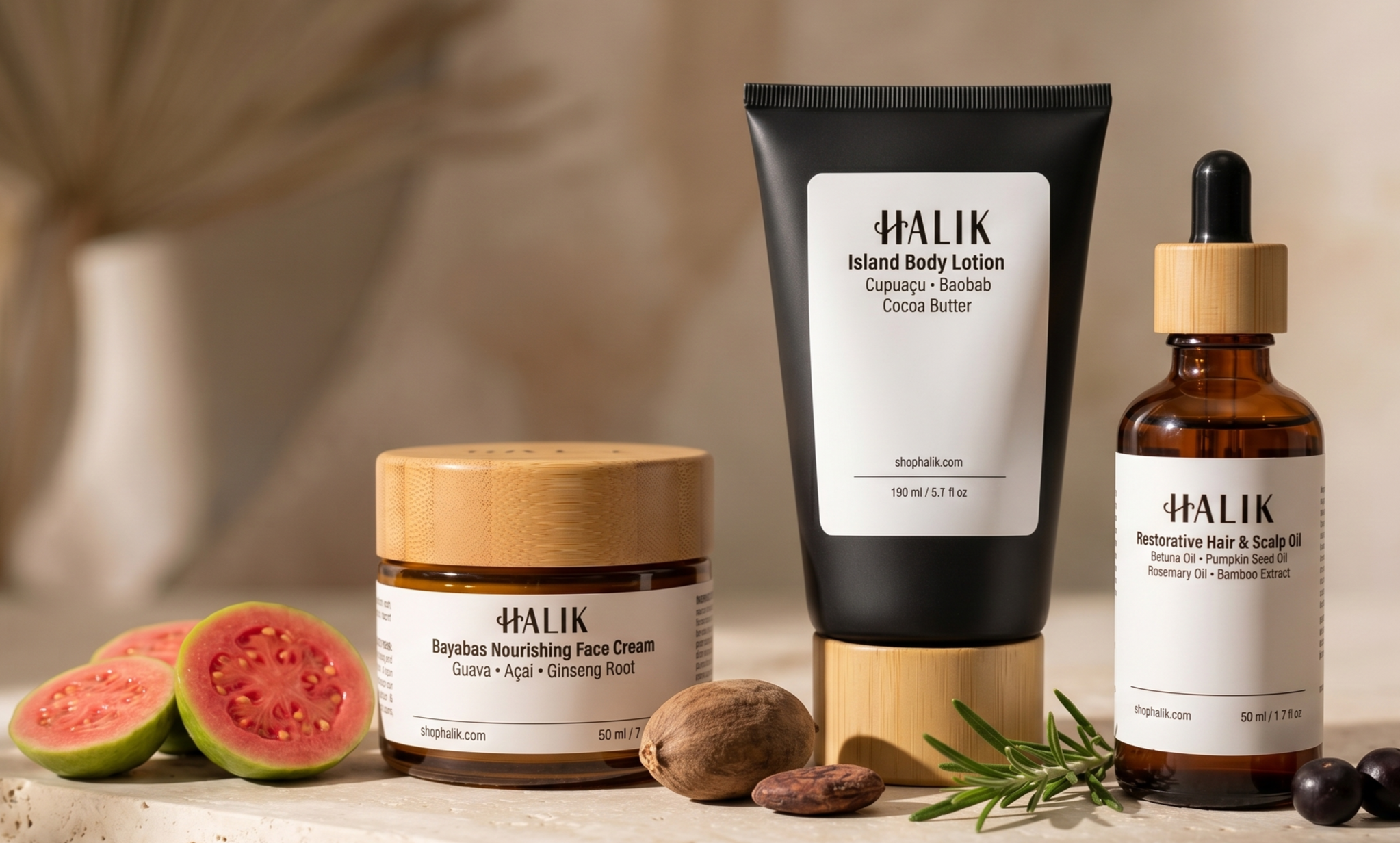
Two products in the current lineup fit naturally into a shared TTC grooming regimen. The Restorative Hair & Scalp Oil replaces synthetic pre-shampoo treatments and leave-in conditioners that often carry parabens and fragrance oils, using batana oil, pumpkin seed oil, and rosemary to support scalp circulation instead. The So Slick Hair Wax Stick and Liyah Hair Texturizing Cream offer a phthalate-free, fragrance-free alternative to conventional edge control and pomade, built on beeswax, castor oil, and lanolin rather than a synthetic hold agent. All were formulated to the same endocrine-safe standard as the rest of the Halik catalog, with full ingredient transparency on every label.
Conventional vs. Endocrine-Safe: What Actually Changes
| Category | Common Conventional Ingredient | What It Does | Endocrine-Safe Swap |
|---|---|---|---|
| Shave gel / aftershave | Fragrance (often containing phthalates) | Anti-androgenic, interferes with testosterone binding | Botanical oil-based finishing products with no synthetic fragrance |
| Shampoo / conditioner | Methylparaben, propylparaben | Weak estrogenic activity, linked to sperm motility in some studies | Gugo bark and botanical-preserved formulas, paraben-free |
| Body wash / soap | Triclosan | Suppresses testosterone synthesis in animal models | Plant-derived cleansing agents without antimicrobial additives |
| Styling products | Synthetic polymers, fragrance oils | Undisclosed "fragrance" often masks phthalate carriers | Beeswax, castor oil, and lanolin-based hold |
The pattern across every row is the same. It is rarely one ingredient causing harm on its own. It is repeated, daily exposure across an entire routine, multiplied across two partners sharing a bathroom.
A Shared Ritual, Not a Solo Fix
TTC is a two-person project, and the grooming shelf should reflect that. Swapping one partner's products while the other keeps their conventional shave gel and deodorant only closes half the gap. When both partners choose ingredient-transparent, endocrine-safe formulas, the household's overall exposure drops together, not in isolation.
None of this replaces medical guidance from a fertility specialist, and no grooming swap is a substitute for a full fertility workup if conception is taking longer than expected. But for the daily choices that are entirely within a couple's control, a shared, intentional regimen is a small act with real reach. A kiss from Mother Earth, for both of you.
FAQ
-
Research links phthalates, parabens, and triclosan, common in shave gels, deodorants, and shampoos, to changes in sperm parameters and hormone signaling. The strongest evidence comes from animal studies, while human research shows a real but more mixed picture, with phthalates carrying the most consistent findings.
-
Phthalates currently have the most consistent human evidence. A review of the available literature found a positive association between urinary phthalate levels and at least one marker of reduced semen quality in every study examined.
-
The evidence is mixed. Some studies link specific parabens, particularly butylparaben, to reduced sperm concentration and motility, while other studies find no significant hormone or semen quality association. Choosing paraben-free where convenient is a reasonable, low-effort precaution rather than a guaranteed fix.
-
No. Start with daily leave-on products like shave gel, deodorant, and hair styling products, since these sit on the skin longest and are typically the most fragrance-heavy. Rinse-off products carry lower relative exposure.
-
Both. Fertility outcomes depend on the health of both partners, and shared household products mean shared exposure. Swapping only one partner's routine leaves the other half of the equation unaddressed.
Sources
Springer Nature Link, "Environmental levels of triclosan and male fertility," 2017
PMC, "Environmental Contaminants Affecting Fertility and Somatic Health"
About Halik
Halik is a clean, premium skincare brand inspired by Filipino botanicals and the healing power of natural ingredients. All Halik products are formulated without parabens, PEGs, phthalates, silicones, sulfates and synthetic fragrances.
Related Reading