Buko Pandan Radiance Toner: A Filipino Dessert Turned Daily Ritual
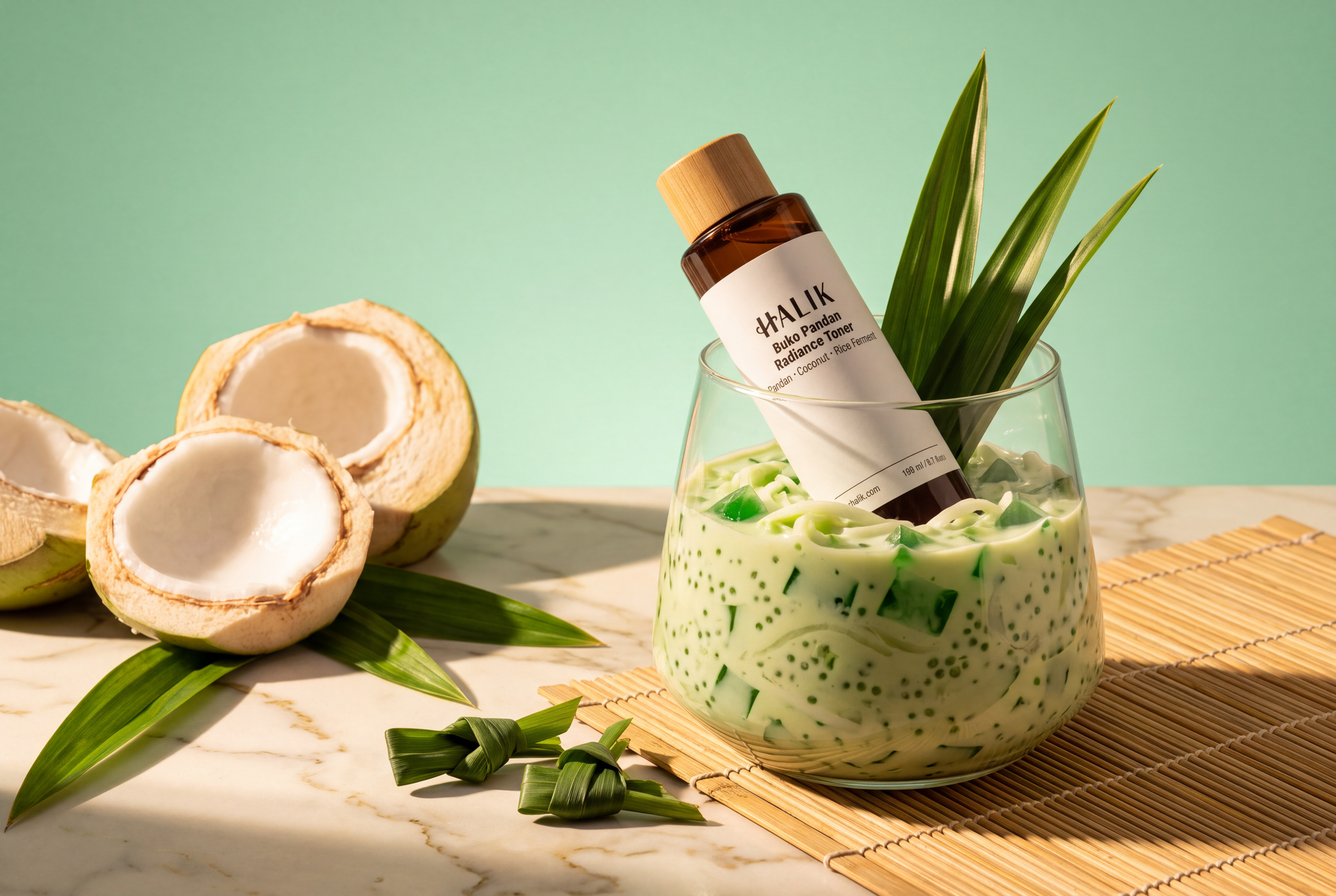
The Halik Buko Pandan Radiance Toner is a 150 ml toner inspired by the Filipino dessert from Bohol. It combines pandan hydrosol, coconut fermented with Lactobacillus, rice ferment filtrate, hydrolyzed rice protein, and a ceramide complex to soften, refresh, and support the skin barrier. Use it after cleansing, morning and evening.
The Halik Buko Pandan Radiance Toner starts with pandan hydrosol, fermented coconut, and rice ferment filtrate. Hydrolyzed rice protein and a ceramide complex finish the formula. Together they soften, refresh, and support your skin barrier. Below is the tradition behind each ingredient and what it does for your skin.
Picture a fiesta table in Bohol. A glass bowl sits at the center. Inside are ribbons of young coconut, cubes of green pandan jelly, and sweet cream. Spoons go in from every side. Nobody eats buko pandan alone.
That dessert is the starting point for this toner. Buko pandan began on the island of Bohol and has since traveled to celebrations and family gatherings across the Philippines. It is less a recipe than a habit of sharing.
We kept the two stars, coconut and pandan. Then we made one change. Rice ferment takes the place that cream holds in the dessert. The original has no rice, so this part is our addition. Rice anchors the Filipino table, and it brings amino acids, minerals, and organic acids to the formula.
What the Toner Does
Softens and refreshes skin on contact with pandan hydrosol.
Supports a balanced, barrier-friendly skin environment with fermented coconut.
Refines tone and texture with rice ferment filtrate, for a soft luminosity.
Smooths the skin's surface with hydrolyzed rice protein.
Seals moisture in and reinforces the skin barrier with a ceramide complex.
Each ingredient carries its own history. Here is how they work, one at a time.
01. Pandan Hydrosol: A Fragrant Staple of Southeast Asian Kitchens
Pandan (Pandanus amaryllifolius) grows across Southeast Asia. Filipino cooks use the leaves to flavor coconut milk dishes and desserts, and buko pandan is the best known. Folk medicine across the region has long used the leaves too, including in the Philippines.
Modern research is early but points in a similar direction. Lab studies on pandan leaf extracts show antioxidant activity. Most of that work tests extracts in the lab, not hydrosol on skin, so we describe the hydrosol by what you feel. It softens and refreshes the moment it touches your face. It also opens the formula, which is why it sits right after water on the ingredient list.
02. Fermented Coconut: The Tree of Life
Filipinos call the coconut niyog, and the young fruit buko. The palm is known as the tree of life here, since nearly every part has a use. People eat the meat, drink the water, press the milk, and build with the wood. Coconut water is a traditional drink for hydration and for recovery during illness. Coconut oil goes on skin and hair. Philippine traditional knowledge records list both the oil and oil-greased leaves as remedies for skin complaints.
In the toner, coconut extract is fermented with Lactobacillus. Fermentation breaks coconut down into forms that deliver its fatty acids more gently. It also supports a balanced, barrier-friendly environment on the skin. You get coconut's nourishment in a light, water-based toner.
03. Rice Ferment Filtrate: An Old Idea in a New Form
Rice water rinses appear in beauty traditions across Asia. Historical accounts describe court women of Japan's Heian period rinsing their hair with water left from washing rice. The Yao women of Huangluo village in China are also known for fermented rice water rinses.
We want to be precise about origins. Those documented practices come from Japan and China, not the Philippines. Rice still sits at the center of the Filipino table, so it fits a formula built on Filipino flavors.
Research on rice water mostly looks at hair. One study in the International Journal of Cosmetic Science found that it reduced surface friction and increased elasticity in hair. Research on skin is earlier, so we focus on what the filtrate holds: amino acids, minerals, and organic acids. Fermenting and filtering turn it into a refined, stable ingredient. It supports tone and texture and gives skin a soft luminosity.
04. Hydrolyzed Rice Protein: Smoothing at the Surface
Hydrolyzed rice protein comes from the same grain in a different form. The protein is broken into small pieces that work at the skin's surface. There they smooth texture and support elasticity. Skin feels replenished rather than stripped.
05. Ceramide Complex: The Skin's Own Architecture
This ingredient is not a tradition. It is biology. Ceramides are fats that sit between skin cells in the outer layer. They help hold the barrier together and keep water in.
A 2019 review in Cosmetics describes how changes in skin ceramide content link to many skin conditions. It also covers how applying ceramides can support barrier function. Our complex pairs ceramide NP, AP, and EOP with phytosphingosine and cholesterol. These are lipids that mirror the skin's own barrier. The result is a toner that seals moisture in and restores a sense of resilience.
Why We Chose It
Every Halik formula is made without parabens, phthalates, sulfates, and synthetic fragrance. This toner also follows our bio-compatible, barrier-support approach. We wanted a toner that works with skin biology instead of stripping it.
The full ingredient list adds niacinamide, beta-glucan, glycerin, and rice bran oil. That keeps the formula light and water-based, so it fits easily under your face cream or oil.
Tradition and Formula, Side by Side
This table shows how each ingredient connects to its source and to its job.
| Ingredient | Where the tradition lives | Its role in the toner |
|---|---|---|
| Pandan hydrosol | Southeast Asian kitchens and folk medicine, including the Philippines | Softens and refreshes on contact |
| Fermented coconut | Philippine food, drink, and skin care | Delivers fatty acids gently and supports a balanced skin surface |
| Rice ferment filtrate | Rice water rinses in Japan and China, and rice at the Filipino table | Supports tone, texture, and soft luminosity |
| Hydrolyzed rice protein | The same grain, in a modern form | Smooths texture and supports elasticity |
| Ceramide complex | The skin's own biology | Seals moisture in and reinforces the barrier |
How to Use It
Cleanse, then pat the toner gently onto face and neck. Use it morning and evening. Follow with our Bayabas Nourishing Face Cream, our Sampaguita Anti-Aging Face Oil, or both, to seal in radiance.
Buko pandan was never meant to be eaten alone. The same spirit shapes this toner. Pat it on slowly. Let coconut, pandan, and rice do their quiet work. Skin meets it dull and leaves it luminous.
Shop the Buko Pandan Radiance Toner (150 ml / 5.1 fl oz)
A kiss from Mother Earth, full of love.
FAQ
-
It is a 150 ml toner built on pandan hydrosol, fermented coconut, and rice ferment filtrate. Hydrolyzed rice protein and a ceramide complex smooth texture and support the skin barrier.
-
Buko pandan is a Filipino dessert that began on the island of Bohol. It combines young coconut, pandan-flavored jelly, and cream. The classic dessert contains no rice.
-
Cleanse, then pat gently onto face and neck morning and evening. Follow with the Bayabas Nourishing Face Cream, the Sampaguita Anti-Aging Face Oil, or both.
-
No. Rice ferment filtrate is a fermented, filtered ingredient designed for stable use in skincare. Homemade rice water changes from batch to batch and lasts only days.
-
Ceramides are fats that sit between skin cells and help hold the barrier together. Our complex pairs them with phytosphingosine and cholesterol to seal moisture in.
About Halik
Halik is a clean, premium skincare brand inspired by Filipino botanicals and the healing power of natural ingredients. All Halik products are formulated without parabens, PEGs, phthalates, silicones, sulfates and synthetic fragrances.
Related Reading