
Ingredient Spotlight: Kukui Nut Oil – Science, Uses & Why We Love It
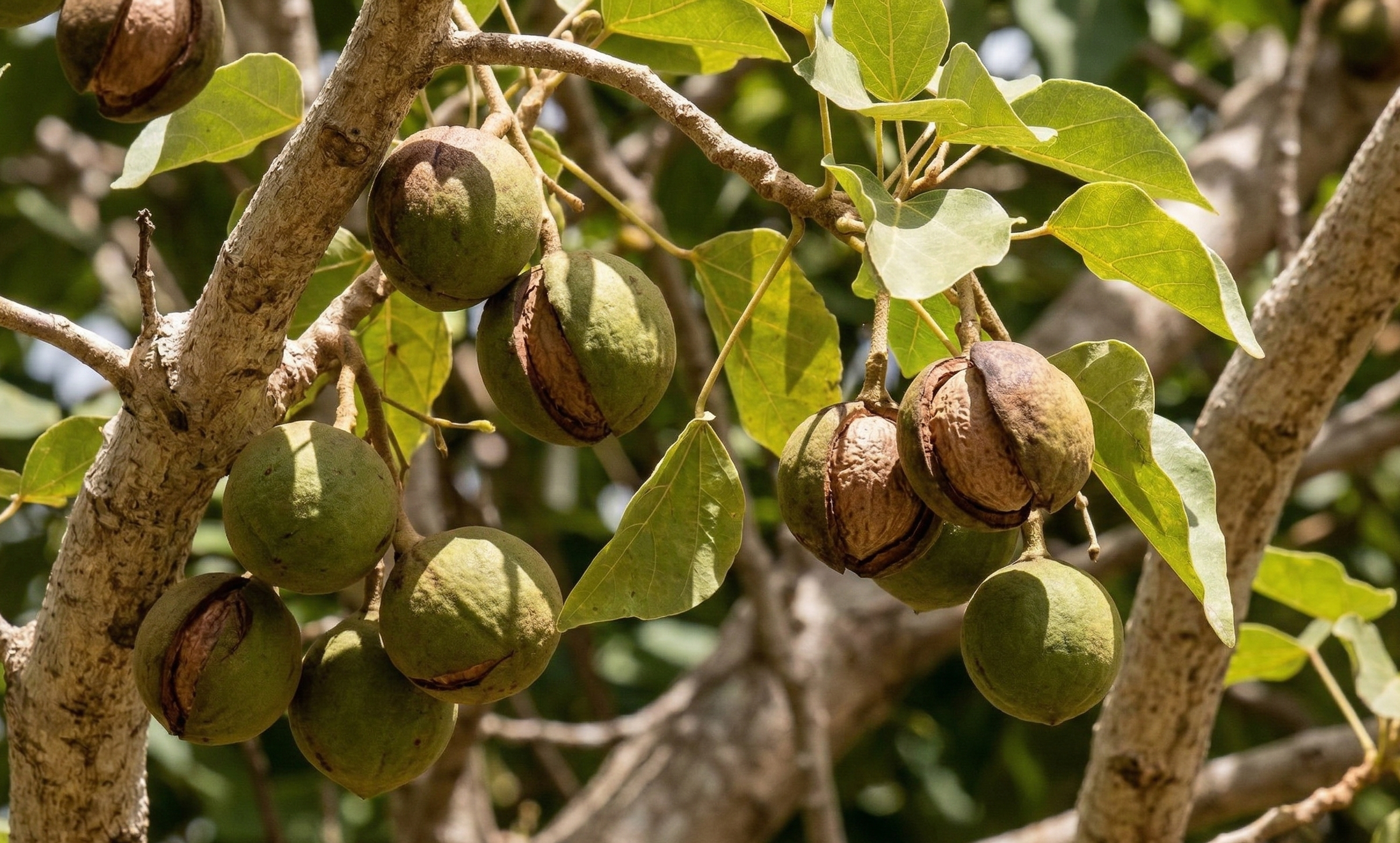
Kukui nut oil, known as lumbang in the Philippines, is a lightweight botanical oil pressed from the seeds of Aleurites moluccana, a tree found throughout the Pacific and Southeast Asia. Its fatty acid profile, rich in linoleic and oleic acid, supports the skin barrier and helps the skin hold onto moisture, while absorbing without the heaviness of denser plant oils. It is a quiet anchor in our Paradise Whipped Body Butter and Island Body Lotion, doing patient, structural work beneath every layer of fragrance and texture.
Some ingredients carry one name. Kukui carries many, and almost all of them point to fire, light, or care. In Hawaii, where the tree is the official state tree, it is kukui. In the Philippines, it is lumbang, a name old enough that an entire lakeside town in Laguna, Lumban, was named after the tree that once grew there in abundance.
This is the story of kukui nut oil. And why a tree once used to light homes is now, in a different form, used to soften skin.
What Is Kukui Nut Oil?
Kukui nut oil is cold-pressed from the seeds of Aleurites moluccana, a tree native across a wide stretch of the Pacific and Southeast Asia, with names and uses recorded in Hawaii, the Philippines, Indonesia, and beyond. For generations, the oil-rich nuts were burned for light, which is where the name candlenut comes from in English. Long before it had a place in skincare, kukui oil was simply how people lit their homes after dark.
Its move into skincare came later, but it followed the same logic. The oil that once fed a flame also turned out to be remarkably good at feeding skin, lightweight, fast-absorbing, and rich in exactly the kind of fatty acids skin needs to stay supple.
Why We Chose It
Halik formulates around three questions for every ingredient: is it bio-compatible, is it endocrine-safe, and does it genuinely restore rather than mask. Kukui nut oil answers all three, and it does so with a name and history that connects directly to the Philippines, not as a borrowed trend, but as an ingredient with its own long-standing local name and use.
When we built Paradise Whipped Body Butter and Island Body Lotion, we wanted an oil that could carry hydration deep without ever feeling like a film on the skin. Kukui's particular balance of fatty acids made it the natural choice.
The Science, Simply Told
01. A Fatty Acid Profile Built for the Skin Barrier
Kukui nut oil is rich in linoleic acid, an omega-6 fatty acid, alongside oleic acid, an omega-9. A clinical review of vegetable oils used in dermal care found that kukui's particular ratio of these two fatty acids, roughly one part oleic to two parts linoleic, improved skin hydration without disrupting the outermost layer of the skin, the stratum corneum, even in skin with a history of sensitivity.
This matters because not every oil behaves this way. Oils heavy in saturated fat tend to sit on the surface. Kukui's polyunsaturated profile lets it integrate into the skin's own lipid structure instead, supporting the barrier from within rather than coating it from above.
02. Lightweight Hydration Without Heaviness
Because kukui oil is high in polyunsaturated fatty acids rather than saturated ones, it behaves differently on skin than denser butters and oils. It absorbs quickly, which is part of why it feels light even in a rich formula like a whipped body butter.
This lightness is not a tradeoff against effectiveness. It is closely tied to how the oil supports skin's natural ability to retain water, working with the skin's own processes rather than simply blocking moisture from leaving.
03. Antioxidant Support from Vitamins A, C, and E
Beyond its fatty acids, kukui nut oil carries vitamins A, C, and E, each playing a distinct supporting role. Vitamin E in particular acts as an antioxidant, helping defend skin against the kind of everyday environmental stress that contributes to premature aging.
This antioxidant content does not replace a dedicated sun care practice. But it does mean kukui oil is doing quiet, background work every time it is applied, alongside its primary job of softening and replenishing.
04. A Long History, Now Backed by Modern Study
Traditional use of kukui oil for skin, particularly to soothe skin after sun exposure, has been documented for generations across the Pacific. Modern dermatological research has begun to test what that tradition already understood: the oil's particular fatty acid ratio has been studied specifically for its hydrating effects on the skin barrier, giving old practice a more precise modern explanation.
Kukui Oil vs Other Botanical Oils
Kukui Oil vs Coconut Oil
Coconut oil is heavier and more occlusive, forming a film that seals moisture in. Kukui oil is lighter and absorbs more quickly, working with the skin's barrier rather than primarily sitting on top of it.
Kukui Oil vs Jojoba Oil
Jojoba oil closely mimics the skin's own sebum, making it a natural fit for balance. Kukui oil takes a different route, supplying essential fatty acids the skin cannot produce on its own to actively replenish the barrier.
How Halik Uses Kukui Nut Oil
Kukui nut oil is valued in Halik formulations like the Paradise Whipped Body Butter and Island Body Lotion for its ability to deliver:
Lightweight hydration
Skin-softening nourishment
Smooth application and absorption
When paired with botanical butters and other oils, kukui oil helps create formulas that hydrate while maintaining an elegant texture.
A Tree With Many Names, One Purpose
Lumbang. Kukui. Candlenut. Every name for this tree points back to the same idea: something useful, something that serves the people who live alongside it. For generations, that usefulness meant light after dark. Now, it means something quieter, an oil that helps skin hold what it needs and let go of what it doesn't.
A kiss from Mother Earth, carried this time in an oil with as many names as the places that have called it their own.
FAQ
-
Kukui nut oil helps moisturize skin, support the skin barrier, and soften hair, all without leaving a heavy residue. Its fatty acid profile makes it especially suited to skin that needs hydration without weight.
Kukui nut oil helps moisturize skin, support the barrier, and soften hair without heaviness.
-
Yes. A clinical review found that kukui oil's fatty acid profile improved skin hydration without disrupting the skin barrier, including in skin with a history of sensitivity, though anyone with a known nut allergy should patch test first.
-
Yes. Its lightweight fatty acid profile helps smooth hair strands and improve manageability without weighing hair down.
-
Yes. Kukui, candlenut, and lumbang are different names for oil from the same tree, Aleurites moluccana, used across Hawaii, the Philippines, and Southeast Asia.
-
Kukui nut oil is cold-pressed from the seeds of Aleurites moluccana, a tree native across the Pacific and Southeast Asia, and known in the Philippines as lumbang.
Discover Halik products with kukui nut oil:
Sources
PMC (National Library of Medicine) — Vegetable Butters and Oils as Therapeutically and Cosmetically Active Ingredients for Dermal Use: A Review of Clinical Studies – https://pmc.ncbi.nlm.nih.gov/articles/PMC9083541/
Wikipedia — Aleurites moluccanus (for the Lumban, Laguna town-name connection and traditional Pacific uses) – https://en.wikipedia.org/wiki/Aleurites_moluccanus
PROSEA / Plant Resources of South East Asia — Aleurites moluccana – https://prosea.prota4u.org/view.aspx?id=71
Learn More About Our Other Ingredients:



About Halik
Halik is a clean luxury skincare brand inspired by Filipino botanicals and the healing power of natural ingredients.
All Halik products are formulated without harmful chemicals, parabens, phthalates, sulfates and synthetic fragrances.
