
Botanical Oils for Hair & Scalp Health
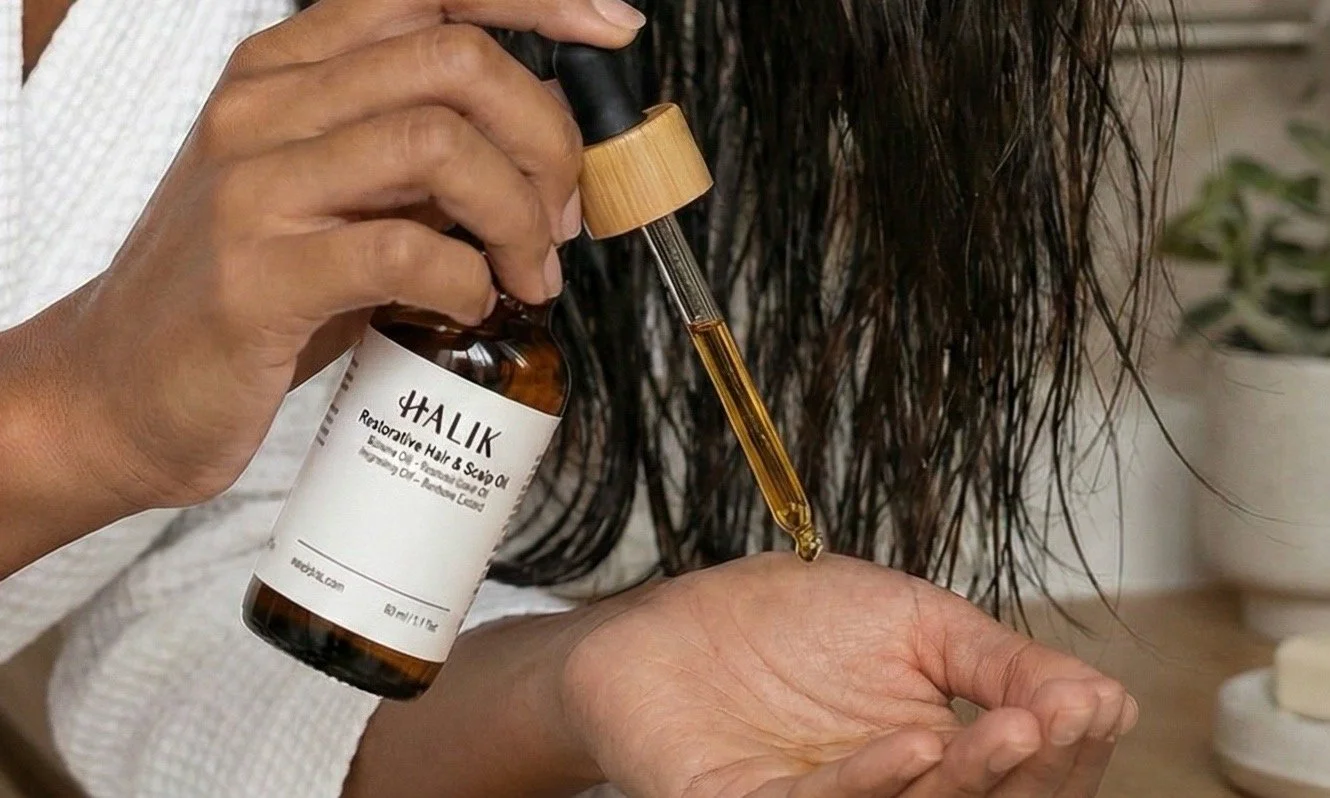
Hair oiling is a centuries-old practice across the Philippines, Central America, and beyond, and modern research is starting to explain why it works. Batana oil strengthens the shaft, pumpkin seed oil targets the enzyme behind thinning, rosemary oil supports scalp circulation with results comparable to a leading topical treatment, and bamboo extract reinforces structure with silica. Halik's Restorative Hair & Scalp Oil brings these four botanicals together in one formula, suited to every hair texture, including 4C.
Before shampoo aisles and styling counters existed, hair oiling was already a ritual. Grandmothers across the Philippines massaged coconut and gugo into their daughters' scalps before a wash. In Honduras, the Miskito people, known as Tawira, or "people of beautiful hair," pressed batana oil from palm nuts by hand and passed the practice down for generations. Neither tradition needed a clinical trial to know that oil, patience, and touch could transform a head of hair. But now, research is starting to explain what these communities already practiced.
At Halik, we built the Restorative Hair & Scalp Oil around four botanicals that carry both heritage and evidence: batana oil, pumpkin seed oil, bamboo extract, and rosemary oil, with hibiscus seed oil rounding out the blend. Below, we break down what each one actually does, what the research says, and where the science is still catching up to tradition.
Why Hair Oiling Works
Hair oiling does two distinct jobs at once, and it helps to separate them.
At the strand, oils rich in fatty acids coat and penetrate the hair shaft. They fill in gaps along the cuticle, reduce the friction that causes breakage, and slow how much water the strand loses and absorbs throughout the day. This is why oiled hair tends to tangle less and hold shine longer.
At the scalp, oil massage increases blood flow to the follicle. Circulation carries oxygen and nutrients to the base of the hair, where new growth begins. Some botanical oils go a step further and interact directly with the biological processes tied to hair thinning, not just circulation.
Both mechanisms matter, and a well-formulated oil should support both.
The Key Botanicals, Explained
Batana Oil: Heritage from the Honduran Rainforest
Batana oil comes from the nut of the American oil palm, Elaeis oleifera, native to the rainforests of Honduras. The Miskito people have pressed and used this oil for generations, hand-cracking and slow-roasting the nuts before extracting the rich, dark oil inside.
Batana is dense in oleic and linoleic fatty acids, the same acids that help seal the cuticle and reduce breakage in oil-treatment research broadly. It's worth noting plainly: large-scale clinical trials on batana oil specifically are still limited, and much of what's known comes from generations of traditional use and its established fatty acid profile rather than peer-reviewed hair-growth studies. We include it for what the evidence does support, strand conditioning and breakage reduction, and we're transparent that the regrowth claims circulating online outpace the current research.
Batana oil also carries a more recent chapter of its story. Herbalist Alfredo Darrington Bowman, known widely as Dr. Sebi, was born in La Ceiba, Honduras, and became one of the most recognized voices in natural and holistic hair care communities before his passing in 2016. He championed batana oil specifically, recommending it for thinning hair, bald spots, and follicles weakened by chemical damage, and pointed to its role in supporting scalp circulation and nourishing the hair from the root. Dr. Sebi's broader health philosophy was not built on clinical trials and remains outside the scope of peer-reviewed medicine, and we're not citing him as a scientific source. But within the herbalism and natural-hair communities that have long trusted batana oil, his advocacy carries real weight, and it's part of why we chose to build this formula around it in the first place.
Pumpkin Seed Oil: Working at the Root Cause
Pumpkin seed oil is one of the more evidence-backed botanicals in hair care right now. A randomized, double-blind, placebo-controlled trial published in Evidence-Based Complementary and Alternative Medicine gave 76 men with mild to moderate androgenetic alopecia either 400 mg of pumpkin seed oil or a placebo daily for 24 weeks. The pumpkin seed oil group showed a significantly greater increase in hair count than the placebo group by the end of the study.
The proposed mechanism centers on phytosterols, plant compounds that appear to inhibit 5-alpha reductase, the enzyme responsible for converting testosterone into DHT. DHT is a major driver of follicle shrinkage in androgenetic hair loss. One important distinction: the clinical trial used an oral supplement, not a topical oil. We include pumpkin seed oil in our formula for its fatty acid and phytosterol content, and we describe its benefits in measured, honest terms rather than promising the same outcome as the oral study.
Rosemary Oil: Comparable Results to a Leading Treatment
Rosemary is the most studied botanical in this formula, and the evidence is genuinely compelling. A 2015 randomized comparative trial published in Skinmed assigned 100 patients with androgenetic alopecia to either rosemary oil or minoxidil 2% for six months. At the six-month mark, both groups showed a statistically significant increase in hair count compared to baseline, with no significant difference between the two groups. Patients using rosemary oil also reported less scalp itching than those using minoxidil.
A more recent narrative review in a peer-reviewed journal (PMC) points to rosemary's anti-androgenic compounds, including 12-methoxycarnosic acid, along with its ability to improve scalp circulation and calm the perifollicular inflammation associated with androgenetic alopecia. The sample sizes involved remain modest by pharmaceutical standards, and researchers are calling for larger, longer trials. Still, few botanicals in hair care have this level of head-to-head clinical comparison behind them.
Bamboo Extract: Structural Reinforcement from Silica
Bamboo is one of the most silica-dense plants used in personal care. Silica plays a structural role in the hair, supporting the internal matrix that gives each strand its elasticity and resistance to snapping under tension. Hair that lacks structural reinforcement tends to feel limp and break more easily during brushing and styling. Bamboo extract works alongside the fatty acids in this formula, addressing texture and resilience rather than the follicle itself.
Hibiscus Seed Oil: Traditional Conditioning Support
Hibiscus has a long history in traditional hair care practices across South and Southeast Asia. Hibiscus seed oil brings conditioning fatty acids to the blend, helping soften the strand and support a fuller, less brittle feel with consistent use. Its role here is complementary: it works alongside batana and bamboo to round out the formula's texture benefits rather than acting on the scalp or follicle directly.
How to Actually Use a Hair Oil
A bottle of oil only works if it's used with intention. There are three ways to bring the Restorative Hair & Scalp Oil into a ritual, depending on the goal.
Scalp treatment. Apply the oil directly to the hairline and scalp and massage it in with your fingertips. Leave it on. This method targets the follicle and supports circulation directly.
Hair oiling. Work the oil through mid-lengths to ends and let it sit for at least 30 minutes, or overnight for a deeper treatment, before shampooing. This is the method closest to traditional oiling practice, and it gives the fatty acids time to penetrate the shaft.
Daily finishing oil. Rub a few drops between your palms and smooth over dry or damp hair to tame frizz and add shine. This is a lighter, everyday application rather than a deep treatment.
For best results, use the oil as a scalp treatment or deep oiling session two to three times a week. The Restorative Hair & Scalp Oil is formulated to suit every hair texture, including 4C.
FAQ
-
Most research on botanical oils and scalp treatments measures results over 24 weeks or longer. Give a consistent oiling practice at least two to three months before judging its effect on thickness or breakage.
-
Some botanicals used in hair oils, notably rosemary and pumpkin seed oil, have clinical research behind them showing measurable increases in hair count. Others primarily improve the strand's texture, shine, and resistance to breakage rather than stimulating new growth. Halik is transparent about which is which in each formula.
-
Not yet in the same way rosemary or pumpkin seed oil are. Batana oil's benefits come from a well-documented fatty acid profile and generations of traditional use by the Miskito people of Honduras, rather than randomized clinical trials specific to the oil itself.
-
Botanical oils rich in fatty acids, like those in the Restorative Hair & Scalp Oil, generally support strand conditioning regardless of hair history. If you have specific scalp sensitivities or a dermatological condition, check with a dermatologist before adding any new product to your ritual.
-
Two to three times a week for a scalp treatment or deep oiling session tends to align with the frequency used in most published research. Daily use as a light finishing oil is fine for texture and shine.
-
Batana oil has roots in both Miskito tradition and, more recently, the natural-hair and herbalism communities shaped by Dr. Sebi, who recommended it for thinning hair and scalp health. His advocacy is part of why we chose batana as a hero ingredient, alongside its established fatty acid profile. We treat his recommendation as heritage and community context rather than clinical evidence, which is why the formula also includes botanicals like rosemary and pumpkin seed oil that carry direct clinical research.
Sources
Cho YH, et al. "Effect of Pumpkin Seed Oil on Hair Growth in Men with Androgenetic Alopecia: A Randomized, Double-Blind, Placebo-Controlled Trial." Evidence-Based Complementary and Alternative Medicine, 2014. PMC.
Panahi Y, Taghizadeh M, Marzony ET, Sahebkar A. "Rosemary Oil vs Minoxidil 2% for the Treatment of Androgenetic Alopecia: A Randomized Comparative Trial." Skinmed, 2015.
"An Overview of Commonly Used Natural Alternatives for the Treatment of Androgenetic Alopecia, with Special Emphasis on Rosemary Oil." PMC.
Traditional use documentation, Miskito (Tawira) batana oil practices, La Mosquitia, Honduras.
Biographical background on Alfredo Darrington Bowman (Dr. Sebi) and his advocacy for batana oil in natural-hair and herbalism communities.
About Halik
Halik is a clean luxury skincare brand inspired by Filipino botanicals and the healing power of natural ingredients.
All Halik products are formulated without harmful chemicals, parabens, phthalates, sulfates and synthetic fragrances.
